
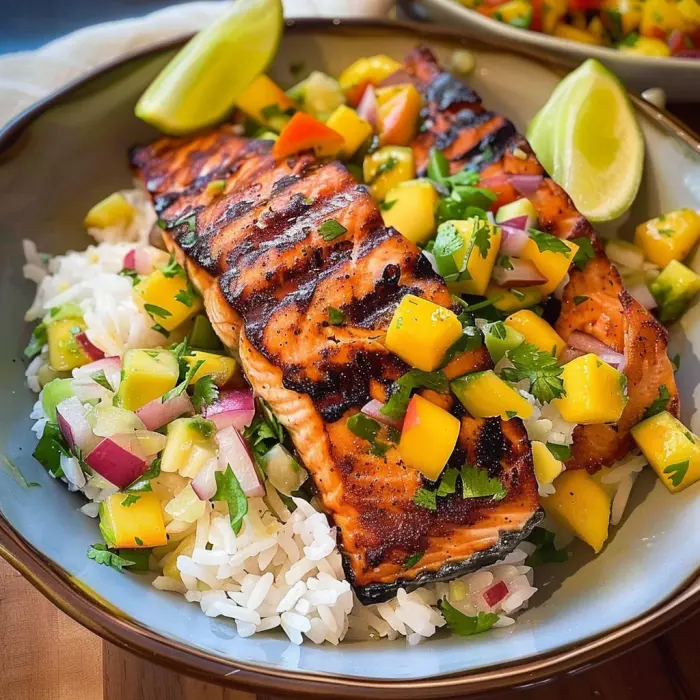
The Ultimate Grilled Salmon with Mango Salsa and Coconut Rice: A Tropical Feast
Picture this, will you? The sun might be setting wherever you are, but one bite of this dish and you’re transported—toes in the sand, a gentle breeze, the sound of waves crashing nearby. We’re talking about a symphony of flavors so vibrant and satisfying, it feels like a vacation on a plate. Honestly, it’s that good.
This isn’t just another healthy recipe; it’s a complete experience. Imagine perfectly grilled salmon, its exterior lightly charred and delightfully crispy while the inside remains impossibly moist and flaky. Then, picture a brilliantly colorful mango salsa, bursting with sweet, spicy, and tangy notes that dance on your tongue. And let’s not forget the pièce de résistance: a bed of luxuriously creamy coconut rice that soaks up every single delicious flavor. Together, they create a harmony that is nothing short of magical.
Furthermore, this meal is a nutritional powerhouse disguised as a decadent treat. Packed with omega-3 fatty acids, lean protein, fresh vitamins, and energy-sustaining carbs, it’s the kind of dinner that makes you feel fantastic long after the last bite is gone. Best of all? It’s far easier to make than it looks. So, let’s ditch the ordinary and embark on a culinary journey to create the ultimate tropical feast. This definitive guide will walk you through every single step, from selecting the finest ingredients to mastering the grill, ensuring your creation is nothing less than spectacular.
Introduction: A Symphony of Tropical Flavors
Alright, let’s get straight to it. What is it about this particular combination that works so unbelievably well? It’s all about the balance, the beautiful contrast between each component that makes every forkful exciting.
Firstly, you have the rich, buttery flavor of the grilled salmon. As a matter of fact, salmon is a robust fish that can stand up to bold accompaniments without getting lost. When cooked properly, it’s flaky and tender, providing a savory, umami-rich foundation for the entire dish. Then, boom! The vibrant mango salsa enters the scene. This isn’t just a condiment; it’s a flavor explosion. The sweetness of the ripe mango, the sharp bite of red onion, the fresh herbaceous kick from cilantro, and the subtle heat from jalapeño all come together, lifted by the bright acidity of fresh lime juice. Consequently, this salsa cuts through the richness of the fish perfectly, creating a refreshing counterpoint.
Meanwhile, the coconut rice plays a crucial, yet often understated, role. Instead of being a plain backdrop, it’s subtly sweet and incredibly aromatic. Moreover, its creamy texture acts as a soothing neutralizer, bridging the gap between the savory fish and the bright salsa. It’s the comforting element that ties the whole tropical experience together, making the meal feel complete and utterly satisfying.
Therefore, this dish is more than the sum of its parts. It’s a carefully orchestrated blend of hot and cool, sweet and savory, rich and fresh. Ultimately, it’s designed to delight your senses and leave you feeling nourished and happy. Ready to create this masterpiece? Fantastic. Let’s start by gathering our tools and the absolute best ingredients. After all, a stunning final dish always begins with quality components.
Gathering Your Ingredients: A Shopping Guide for Freshness
Honestly, the secret to an unforgettable meal lies right here, in the quality of what you bring home. Since this dish relies on simple, fresh components, each one truly needs to shine. Don’t worry, though; none of it is complicated to find! Let’s break down your shopping list into the dream team for each element of this healthy recipe.
For the Perfect Grilled Salmon:
First up, the star of the show: the fish. You’ll want beautiful salmon fillets, about 1 to 1.5 inches thick. This thickness is ideal for getting a gorgeous sear on the outside without overcooking the interior. Now, the age-old question: skin-on or skin-off? While it’s a matter of preference, skin-on salmon is highly recommended. Why? Well, the skin gets fantastically crispy on the grill and acts as a natural barrier, protecting the delicate flesh from drying out. Furthermore, the choice between wild-caught and farmed is worth considering. Wild-caught salmon often has a leaner texture and a more robust, oceanic flavor, while farmed is typically richer and fattier. Both are delicious, so choose what’s best for your budget and taste.
Next, you’ll need a high-smoke-point oil. Avocado oil or grapeseed oil are perfect contenders here because they can handle the grill’s high heat without burning and smoking excessively. Finally, keep your seasoning simple. Coarse kosher salt and freshly cracked black pepper are non-negotiable. However, feel free to add a pinch of paprika or garlic powder for an extra layer of flavor.
For the Vibrant Mango Salsa:
This is where the color and freshness explode! Your mission is to find ripe, fragrant mangoes. Give them a gentle squeeze; they should yield slightly like a ripe avocado. Trust your nose, too—a sweet, tropical aroma at the stem end is a dead giveaway. The most common varieties are Ataulfo (Honey mangoes), which are smaller, creamy, and less fibrous, and the larger Tommy Atkins or Kent mangoes, which are also excellent.
Beyond the mango, grab a crisp red onion for its sharp bite, a bunch of fresh cilantro, and a jalapeño or serrano pepper. Remember, the heat primarily lives in the seeds and white membranes, so you can control the spice level easily. Finally, snag a few juicy limes. Absolutely nothing from a bottle can compare to the zing of fresh lime juice here.
For the Creamy Coconut Rice:
For the base of our tropical feast, you’ll need a long-grain rice. Jasmine rice is the absolute champion for this; it’s fragrant, slightly sticky, and wonderfully absorbent. Secondly, the namesake ingredient: coconut milk. Please, for the love of flavor, use full-fat canned coconut milk. The light version simply won’t deliver the same luxurious, creamy texture. Shake the can well before you open it! You’ll also need some water and a pinch of salt to balance the sweetness.
Essential Kitchen Tools
You don’t need a kitchen full of fancy gadgets for this easy dinner idea. In fact, you likely have everything already:
-
A reliable grill (gas or charcoal) or a heavy-duty grill pan for indoor cooking.
-
A sharp chef’s knife and a sturdy cutting board for prepping all your fresh ingredients.
-
A few mixing bowls—one for the salsa and perhaps another for marinating.
-
A fine-mesh strainer for rinsing your rice, which is a crucial step for non-clumpy results.
-
A medium saucepan with a tight-fitting lid for cooking the coconut rice to perfection.
-
Tongs and a flexible fish spatula—this thin-edged spatula is a game-changer for flipping delicate salmon fillets without them falling apart.
Crafting the Coconut Rice: The Pillowy Base
Alright, let’s get cooking! We’re starting with the rice because it can happily sit off the heat, staying warm and fluffy while you finish the other components. This is a simple process, but a few pro tips make all the difference.
First things first, rinse your rice! Place it in that fine-mesh strainer and run cold water over it, swishing it around with your hand until the water runs almost clear. This step washes away excess surface starch, preventing your rice from turning into a gummy mess. It’s the secret to distinct, separate grains.
Now, for the liquid ratio. A standard and foolproof ratio is 1 cup of jasmine rice to 1 ½ cups of liquid. For maximum coconut flavor, I use a mix of ¾ cup full-fat coconut milk and ¾ cup water. Combine the rinsed rice, coconut milk, water, and a good pinch of salt in your saucepan. Give it a quick stir.
Bring the pot to a gentle boil over medium-high heat. Then, immediately reduce the heat to the lowest possible setting, cover it tightly with the lid, and walk away. Do not peek! Let it simmer undisturbed for 15-18 minutes. After that time, turn off the heat and let it sit, still covered, for another 10 minutes. This resting period is non-negotiable; it allows the rice to finish steaming and become perfectly tender. Finally, fluff it gently with a fork, and it’s ready to serve.
Preparing the Mango Salsa: A Dance of Freshness
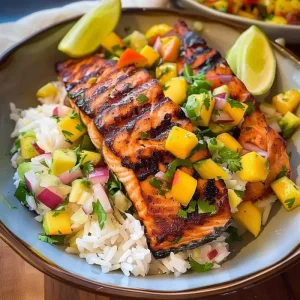
While the rice is working its magic, let’s make the salsa. This is where your knife skills get a quick workout, but it’s incredibly simple. The goal is a fine, uniform dice so you get a bit of every flavor in each spoonful.
Start by tackling the mango. Slice off the two fleshy cheeks on either side of the flat pit. Then, carefully score the flesh of each cheek in a cross-hatch pattern without cutting through the skin. Finally, push the skin side up to invert the cheek, and you can easily slice the mango cubes away from the skin. It’s much easier than it sounds!
Next, finely dice a bit of red onion—you don’t need much. Then, move on to the jalapeño. For a milder salsa, slice it in half and scrape out the seeds and white ribs with a spoon before dicing. For more heat, leave some in! Chop a handful of fresh cilantro.
Now, combine the mango cubes, diced onion, jalapeño, and cilantro in a bowl. Pour over the fresh lime juice, add a pinch of salt, and give it all a gentle toss. Here’s a major tip: let this salsa sit for at least 15-20 minutes before serving. This waiting period, called maceration, allows the flavors to meld and get to know each other, transforming it from chopped ingredients into a cohesive, incredible salsa.
Mastering the Grilled Salmon: The Star of the Show
This is it—the main event! Cooking salmon can intimidate people, but I promise, with a few key techniques, you’ll achieve a restaurant-quality sear every single time.
Pre-Grill Preparation:
Patience starts now. Take your salmon fillets out of the fridge about 15 minutes before grilling. Letting them come closer to room temperature is a small step that ensures they cook evenly from edge to center. Meanwhile, pat them completely dry with paper towels. This is the most critical step for getting that crispy, non-stick skin. Moisture is the enemy of browning! Then, lightly brush both sides with your high-heat oil and season generously with salt and pepper.
Grilling Techniques for Perfection:
Fire up your grill to medium-high heat. You know it’s ready when you can hold your hand about an inch above the grates for only 3-4 seconds. Crucially, clean your grates well and oil them thoroughly with a folded paper towel dipped in oil and held with tongs.
Place your salmon fillets skin-side down (if they have skin) on the grill at a 45-degree angle to the grates; this gives you those beautiful professional grill marks. Now, here comes the hard part: don’t touch it! Let it cook for about 90-95% of the total time on that one side. For a standard 1.5-inch fillet, this is usually 5-6 minutes. The skin will become crispy and release easily from the grates when it’s ready.
If you want grill marks on the other side, flip it gently with a fish spatula and cook for just another minute or two. Otherwise, you can even cook it entirely on the skin side without flipping. How do you know it’s done? The salmon will turn from translucent to opaque, and it will flake easily when tested with a fork. For the most accurate result, an instant-read thermometer should read between 125°F (for medium-rare) and 135°F (for medium) in the thickest part.
The Rest is Key:
Just like a steak, salmon needs to rest! Transfer it to a clean plate and let it sit for about 5 minutes. This allows the juices to redistribute throughout the fillet, guaranteeing that every single bite is moist and flavorful.
Chef’s Secrets: Elevating Your Dish from Good to Great
You’ve got the basics down, but why stop there? Let’s talk about how to truly become a master of this dish with some simple pro tips.
-
For the Salmon: If you’re nervous about the fish sticking, try grilling on a cedar plank. Soak the plank in water for an hour, then place it on the grill, put the salmon on top, and close the lid. It gently steams and smokes the fish, infusing it with an amazing woody aroma and making it absolutely foolproof.
-
For the Salsa: Feel free to play with textures and flavors! Adding some diced creamy avocado or crunchy cucumber right before serving introduces a wonderful new dimension. If your mango isn’t super sweet, a tiny drizzle of honey or agave nectar can balance the acidity perfectly.
-
For the Rice: Take your rice from great to extraordinary by toasting it. Before adding the liquid, sauté the rinsed and drained rice in a little coconut oil for 1-2 minutes until it smells nutty. Then, add your liquids and proceed as usual. This adds a incredible depth of flavor.
Creative Variations and Dietary Tweaks
This tropical template is incredibly versatile. Don’t be afraid to make it your own!
-
Protein Swaps: Not a salmon fan? No problem. This salsa and rice combo is fantastic with grilled shrimp, chicken breast, or even firm tofu for a plant-based option.
-
Salsa Variations: Think of the mango salsa as a formula. You can swap the mango for peaches or nectarines when they’re in season. A black bean and corn salsa would also work beautifully here.
-
Rice Variations: For a lower-carb option, you can serve your salmon and salsa over cauliflower rice. Simply sauté riced cauliflower in a pan with a couple of tablespoons of coconut milk until tender. Quinoa is another fantastic, protein-packed alternative.
A Nutritious Powerhouse: The Health Benefits
This dish isn’t just a treat for your taste buds; it’s a genuine boost for your body. It’s the epitome of food that makes you feel as good as it tastes.
The grilled salmon is the undeniable nutritional hero. It’s famously packed with omega-3 fatty acids, which are essential for heart and brain health. Furthermore, it’s an incredible source of high-quality protein to keep you full and satisfied, and it’s one of the few natural food sources of Vitamin D.
The mango salsa is basically a vitamin bomb in a bowl. Mangoes are loaded with Vitamin C for immune support and Vitamin A for eye health, not to mention a good amount of fiber. The cilantro, lime, and onions contribute their own antioxidants and phytonutrients.
Even the coconut rice brings valuable benefits. It provides complex carbohydrates for sustained energy. Additionally, the fats in coconut milk are primarily Medium-Chain Triglycerides (MCTs), which are a unique type of fat that your body can metabolize very quickly for energy.
The Perfect Pairing: What to Serve With It
While this meal is complete on its own, a simple side can round it out perfectly. A light, crisp green salad with a simple citrus vinaigrette provides a refreshing crunch. Alternatively, some simply grilled asparagus or zucchini would be a wonderful addition. For a visual guide on how to cut a mango, many great culinary websites offer step-by-step photos that can be very helpful for beginners.
Making Ahead and Storing Leftovers
-
Salsa: You can absolutely make the mango salsa up to 1 day in advance. Keep it in an airtight container in the refrigerator. It might release a little more liquid, so just give it a stir before serving.
-
Rice: Coconut rice is best served fresh, but leftovers can be stored for 3-4 days in the fridge. Reheat it in the microwave with a splash of water or coconut milk to bring back its moisture.
-
Salmon: For the best texture, salmon is ideally served immediately after cooking. However, leftover cooked salmon can be stored in the fridge for 2 days. Reheat it gently in a low oven or air fryer to avoid overcooking and drying it out.
Frequently Asked Questions (FAQs)
Can I use frozen salmon?
Absolutely! Thaw it completely in the refrigerator overnight first. This is the safest method. Once thawed, pat it extremely dry with paper towels before oiling and seasoning to ensure a good sear.
My salmon always sticks to the grill! How do I prevent it?
This is a common frustration! Usually, the culprit is one of three things: a grill that isn’t hot enough, grates that aren’t clean or properly oiled, or fish that wasn’t patted dry. Ensure your grill is preheated, your grates are pristine and slick with oil, and your salmon is bone-dry. Then, be patient and don’t try to move it until it releases naturally.
How do I know when the mango is ripe?
Ripe mangoes will yield slightly to gentle pressure, similar to a ripe avocado. They should also have a full, fruity aroma at the stem end. Color is not always the best indicator, as some varieties remain green even when ripe. For more information on selecting and storing fruits, the USDA’s FoodData Central provides detailed nutritional information for mangoes and other produce.
Can I make this recipe if I don’t have a grill?
You certainly can! A grill pan over medium-high heat will work beautifully to get those char marks. Alternatively, you can pan-sear the salmon skin-side down in a hot skillet with a little oil. You can also bake it in a preheated 400°F (200°C) oven for about 12-15 minutes, depending on thickness.
Is canned mango okay to use for the salsa?
In a true pinch, yes, but the texture and flavor will be significantly different. Canned mango is often much softer and sweeter in a syrupy way. If you must use it, choose mango canned in juice (not heavy syrup), drain it very well, and pat it dry. Fresh mango is always worth the effort for the best result. When selecting seafood, always consider sustainable seafood choices to support healthy oceans.
Print
Grilled Salmon with Mango Salsa and Coconut Rice
Description
Grilled Salmon with Mango Salsa and Coconut Rice
🐟 For the Salmon
Ingredients:
-
4 salmon fillets (6 oz each, skin on)
-
2 tbsp olive oil
-
2 tbsp lime juice
-
2 cloves garlic, minced
-
1 tsp honey (optional, for caramelization)
-
1 tsp paprika
-
½ tsp salt
-
½ tsp black pepper
Instructions:
-
In a small bowl, whisk olive oil, lime juice, garlic, honey, paprika, salt, and pepper.
-
Brush marinade over salmon and let sit 15 minutes.
-
Preheat grill (or grill pan) to medium-high.
-
Grill salmon, skin-side down first, 4–5 minutes per side, until cooked through and flaky.
🥭 For the Mango Salsa
Ingredients:
-
1 ripe mango, diced
-
½ red bell pepper, finely diced
-
½ red onion, finely diced
-
1 jalapeño, seeded and minced (optional, for heat)
-
2 tbsp fresh cilantro, chopped
-
Juice of 1 lime
-
Pinch of salt
Instructions:
-
Combine mango, bell pepper, onion, jalapeño, cilantro, lime juice, and salt in a bowl.
-
Toss gently and refrigerate until ready to serve.
🥥 For the Coconut Rice
Ingredients:
-
1 cup jasmine rice
-
1 cup coconut milk (canned, full-fat)
-
1 cup water
-
½ tsp salt
-
1 tsp sugar (optional, enhances coconut flavor)
Instructions:
-
Rinse rice under cold water until clear.
-
In a saucepan, bring rice, coconut milk, water, salt, and sugar to a boil.
-
Reduce heat, cover, and simmer 15 minutes or until rice is tender.
-
Fluff with a fork before serving.